Jigsaw Drop: Solitaire Puzzle
RunyouPuzzle
4.71.64K Reviews
- Version
- 1.1.6
- Installs
- 5.00M
- Age Rating
- Everyone
Screenshots
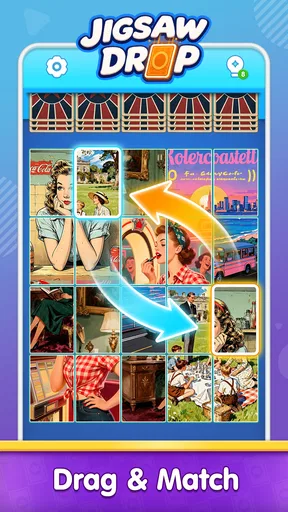
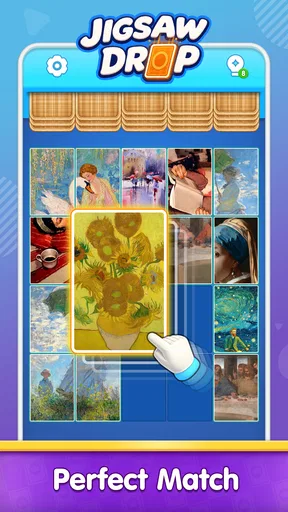
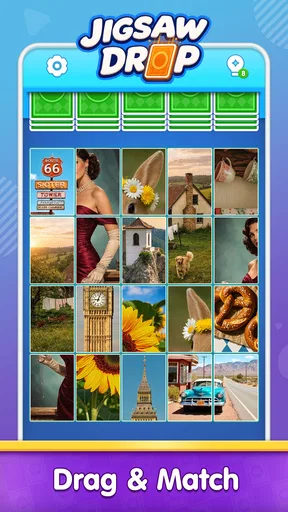
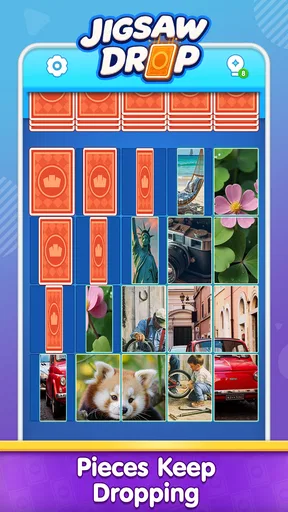
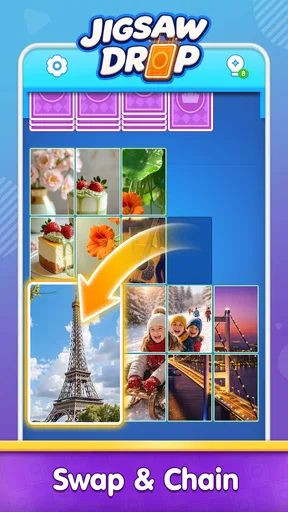
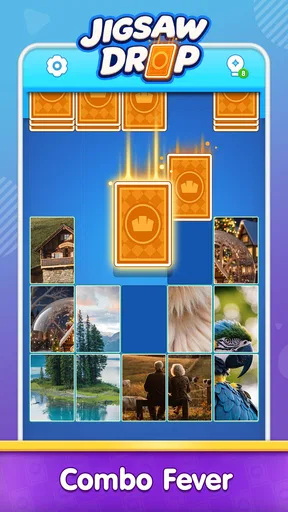
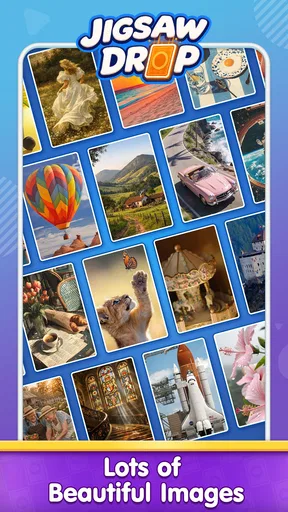
Our Review of Jigsaw Drop: Solitaire Puzzle
 Analysis by Appyee
I approached Jigsaw Drop: Solitaire Puzzle as the kind of game I could open without preparing for a long session. It is a free puzzle game from Runyou, built around matching pictures through simple moves and a calm pace. That sounds straightforward, and it is, but the appeal is in how little pressure the basic idea creates. I can start with a few spare minutes, make visible progress quickly, and stop without feeling that I have abandoned a complicated challenge.
My first impression was that this is aimed at people who enjoy arranging pieces more than racing against a clock. The game belongs to the puzzle category, carries an Everyone age rating, and is available for devices running Android 7.0 or later. Those details make it approachable for a wide range of players, especially anyone looking for a gentle alternative to faster match-three games or demanding traditional jigsaws.
The important thing to understand before installing it is that this is not trying to replace a large physical puzzle collection. Its strength is convenience. There is no table to clear, no loose piece to lose, and no need to reserve an evening for one image. I see it as a small, repeatable relaxation activity: something for a commute, a waiting room, or the few minutes after finishing work.
What the first session feels like
After opening the game, I would recommend treating the first puzzle as a tutorial in disguise rather than trying to solve it perfectly. The main action is matching picture elements with smooth movements, so the early satisfaction comes from recognizing a useful relationship and seeing the board become more orderly. That immediate visual feedback matters because it tells a new player what the game considers a good move without requiring a long explanation.
The controls are best approached with deliberate touches instead of hurried swipes. When I slow down enough to look at the image fragments, the puzzle becomes less about guessing and more about noticing colors, edges, and repeated visual details. This is a useful distinction from many mobile puzzle games, where speed or chain reactions dominate the experience. Here, patience is not merely tolerated; it is part of the rhythm.
A realistic everyday use case is a short break between tasks. I might open it while waiting for a meeting, complete a small amount of arranging, and then put the phone away. The game suits that pattern better than a traditional jigsaw app that expects me to remember a large unfinished layout. It also works when I want something more engaging than scrolling but less mentally demanding than a strategy game.
The visual matching theme gives the game a softer personality than number puzzles or word challenges. I do not need to calculate, memorize a vocabulary, or learn a complicated rule set. I only need to inspect what is on screen and decide which movement makes the picture more coherent. For a first-time player, that makes the path to a meaningful success reassuringly short.
Still, the relaxing presentation will not suit everyone. If you want constant novelty, competitive scoring, or a strong sense of danger, the gentle structure may feel too quiet. Players who enjoy the tension of a countdown or the satisfaction of building huge combos may prefer a match-three title. Jigsaw Drop: Solitaire Puzzle is more appropriate when the process of sorting and completing matters as much as the result.
Getting started without overthinking the board
Once the game is installed, I suggest beginning with the simplest visible area rather than scanning the entire puzzle at once. Look for a distinctive color or a recognizable part of the picture. A bright object, a clear boundary, or a repeated pattern usually gives the eye something concrete to follow. Completing one small relationship can make the rest of the board easier to read.
One practical habit is to use the image as a guide, not as decoration. New players often focus on individual pieces and forget to step back mentally to see the larger composition. I get better results when I alternate between close inspection and a quick look at the whole picture. That prevents me from becoming stuck on two pieces that seem similar while another obvious match is waiting elsewhere.
Another useful approach is to avoid moving a piece simply because it is available. A move should either improve the picture or reveal information. This small rule reduces unnecessary rearranging and makes the session feel more controlled. It also helps when the board becomes visually busy, because I can retrace my thinking instead of making random changes.
The first successful action should be treated as a checkpoint. When a match produces a clearer section of the image, pause for a moment and identify why it worked. Was it a shared color, a continuous line, or a recognizable object? Learning to notice that clue is more valuable than rushing into the next move. The game becomes easier when I stop seeing pieces as isolated shapes and start seeing them as parts of a visual sentence.
This is also where the “solitaire” character becomes useful. I am not depending on another player, a team, or a leaderboard to make progress feel worthwhile. The reward is private and immediate: the board looks better because I made a sensible decision. That makes the game suitable for quiet play, including moments when I do not want to communicate or compete.
The small details that make matching easier
One non-obvious tip is to use texture as carefully as color. Two pieces can share a blue background but belong to different parts of the image, while a faint line or change in shading may reveal the correct relationship. When I rely only on the strongest color, I create false matches. Looking for direction, contrast, and continuation is more reliable.
A second tip is to work from stable visual landmarks. If a section contains a face, object, border, or sharply defined shape, I use that area to orient myself before handling less distinctive pieces. This is especially helpful when several fragments have similar backgrounds. The landmark becomes an anchor, and the surrounding pieces can be judged against it rather than against the whole board.
A third trade-off is the balance between speed and clarity. Fast movements may feel satisfying, but they can make the layout harder to understand if I act before confirming the picture. Slower play is usually the better choice when I am learning the game or returning after a break. Once the visual logic becomes familiar, I can move more quickly without turning the session into guesswork.
I also recommend stopping at a natural point instead of forcing completion when attention starts to fade. Because the game is designed for relaxing play, it loses some of its charm if I treat every session like an obligation. A short, successful sequence is still a worthwhile result. This is one reason it works well as a break activity rather than only as a dedicated puzzle night.
Where new players may hesitate
The most common confusion for a first-time user is assuming that every available movement must be useful. In a picture-matching puzzle, the board can present several plausible choices at once. I find it better to test the move that has the strongest visual evidence, then reassess the new arrangement. The goal is not to touch everything immediately; it is to reduce uncertainty one decision at a time.
Another point of friction is the difference between recognizing a picture and understanding its structure. I may know what an image shows but still not know which fragment belongs next to another. In those moments, I focus on continuity: lines should continue, surfaces should make sense, and edges should form a believable boundary. This approach is more dependable than relying on a vague feeling that two colors “look close.”
Players coming from conventional jigsaw apps may also expect a free-form tabletop layout in which pieces can be scattered anywhere. This game’s drop-and-match style gives the experience a more directed flow. That is convenient on a phone because the screen stays readable, but it may feel less tactile than dragging dozens of loose pieces around a large virtual table. If the physical act of browsing a pile is your favorite part of jigsaws, this is a meaningful limitation.
Likewise, people used to competitive puzzle games should adjust their expectations. The store summary emphasizes smooth moves and relaxing gameplay, and that description matches the mood I get from it. I would not choose it as my main game for testing reaction speed or chasing dramatic score improvements. Its appeal is steadiness, visual order, and the modest satisfaction of making the next correct arrangement.
The game’s broad accessibility is a strength, but it also means the early experience may feel simple to expert puzzle players. Someone who wants complex deduction, intricate rules, or a deep campaign may outgrow the basic matching loop. In that situation, a traditional jigsaw app with larger layouts or a logic game with layered mechanics could provide more challenge. Jigsaw Drop: Solitaire Puzzle is at its best when simplicity is a feature rather than a problem.
It is worth paying attention to the device requirement before trying it on an older phone or tablet. The minimum operating system is Android 7.0, so devices below that level are not the right fit. For compatible users, the free price makes experimentation easy: I can try the opening puzzles without committing money, then decide whether the calm matching loop deserves a place in my regular rotation.
Who will enjoy it most
I would recommend this game to someone who likes visual puzzles but does not always have the time or space for a full jigsaw. It is also a good match for players who prefer solo activities, gentle concentration, and progress that can be made in short sessions. The Everyone rating reinforces that approachable positioning, although individual tolerance for repetition and visual focus will still vary.
It can be particularly useful as a transition activity. After a busy day, I may not want a demanding game, but I may also want something more intentional than opening social media. A few careful matches give my attention one manageable task. The best result is not necessarily finishing a complete picture; it is leaving the session feeling that my mind has slowed down.
On the other hand, I would steer away from it if your priority is social play, intense competition, or a constantly changing set of rules. It is also not the obvious choice for someone seeking a realistic digital recreation of assembling a physical jigsaw. The compact mobile format favors accessibility and quick interaction over the spacious, tactile feeling of a tabletop puzzle.
The game’s reception suggests that the concept has found a substantial audience: it holds a 4.7 average from around 162 thousand ratings and has passed five million installs. I read those figures as evidence that the straightforward format connects with many players, not as a guarantee that every puzzle fan will enjoy it. A calm game can be widely liked and still feel too undemanding for a player who wants constant pressure.
What to do after the first success
After completing the first satisfying match, I would keep the next session focused on consistency rather than speed. Try to identify the visual clue behind each good move. If a section is confusing, leave it temporarily and work on a clearer landmark. This creates a practical workflow: secure what you understand, use that progress to clarify the uncertain area, and return only when the board offers better evidence.
It is also helpful to decide what kind of session you want before opening the game. For a two-minute break, aim for one or two confident actions. For a longer quiet period, spend more time studying the picture and refining the arrangement. This simple choice prevents the game from feeling either rushed or aimless, and it makes the same core mechanics fit different parts of the day.
Runyou has kept the product at version 1.0.13, which is the version I would look for when checking compatibility before installing. I would also keep expectations realistic around updates: the lasting value here comes from whether the matching loop remains pleasant for me, not from assuming it will turn into a completely different type of puzzle.
Compared with ordinary jigsaw alternatives, the strongest advantage is immediacy. I can pick it up without setting up a virtual table or committing to a large image. Compared with match-three games, its advantage is the calmer pace and reduced emphasis on explosive combinations. The trade-off in both comparisons is depth: players wanting richer systems, competition, or a more tactile puzzle environment may find another category more rewarding.
My final recommendation is simple: install it if you want a free, low-pressure picture puzzle that makes small moments feel usefully occupied. Give the first session a fair chance by looking for landmarks, checking texture as well as color, and resisting random moves. The best way to enjoy Jigsaw Drop: Solitaire Puzzle is to treat each match as a small act of visual problem-solving, not a race.
For me, that balance is the reason Jigsaw Drop: Solitaire Puzzle works. It does not need complicated rules to create a satisfying pause in the day. Its limitations are clear, especially for players seeking competition or advanced puzzle depth, but within its intended space it is easy to approach and pleasant to return to. If a quiet sequence of picture matches sounds better than a frantic challenge, this is a sensible place to start.
Privacy and Permissions
See what permissions an app requests and how it handles your data.
- Photos/Media/Files
- read the contents of your USB storage, modify or delete the contents of your USB storage
- Storage
- read the contents of your USB storage, modify or delete the contents of your USB storage
- Wi-Fi connection information
- view Wi-Fi connections
- Other
- view network connections, full network access, control vibration, prevent device from sleeping, Google Play license check
Verdict
Strengths of Jigsaw Drop: Solitaire Puzzle
- Simple drag-and-drop controls are easy to learn.
- Short rounds make it suitable for quick breaks.
- Relaxing gameplay works well without time pressure.
- Progressive challenges keep the puzzle format engaging.
- Clean visuals make individual pieces easy to identify.
Limitations of Jigsaw Drop: Solitaire Puzzle
- Some levels may feel repetitive after extended play.
- Larger puzzles can become difficult on smaller phone screens.
- Hints or assistance may be limited during tricky layouts.
- The game may offer fewer features than full solitaire titles.
- Frequent ads could interrupt the flow for some players.
Other Releases by Runyou
View All
Cat Beats - Tiles Music Games
Music4.5

Farm Madness: Traffic Jam
Casual4.5
Similar Picks in This Category
View All
Block Blast!
HungryStudio4.8

Braindom: Brain Games Test
Lahana Game Studio4.6

AMAZE!
CrazyLabs LTD4.6

Sudoku - Classic Sudoku Puzzle
Oakever Games4.7

Art Puzzle - Puzzle Games
Easybrain4.8

Amaze GO!
Oakever Games4.9
Frequently Asked Questions
What is Jigsaw Drop: Solitaire Puzzle?
Jigsaw Drop: Solitaire Puzzle combines traditional jigsaw solving with solitaire-style card mechanics. Instead of simply placing pieces from a scattered board, you progress by completing puzzle sections and matching pieces through the game’s drop-based system. It is designed for casual play, with short levels, colorful artwork, and gradually increasing challenges that make it suitable for relaxing sessions or quick entertainment.
Is Jigsaw Drop: Solitaire Puzzle free to download and play?
The game can generally be downloaded for free on supported mobile devices, but it may include optional in-app purchases. These purchases can provide hints, extra moves, boosters, or other conveniences, depending on the version available in your region. Before downloading, it is worth checking the store listing for current pricing, advertisements, and any purchase requirements.
Does the game require an internet connection?
Jigsaw Drop: Solitaire Puzzle may allow some gameplay without a constant internet connection, which is useful when traveling or when mobile data is unavailable. However, features such as advertisements, cloud synchronization, rewards, updates, or in-app purchases may require connectivity. Offline availability can differ between versions, so testing the game after installation is recommended.
Is Jigsaw Drop: Solitaire Puzzle suitable for children?
The game is generally easy to understand and does not usually require advanced reading or complicated controls, making it approachable for many younger players. Nevertheless, parents should review the age rating, advertising content, and in-app purchase settings before allowing children to play. Puzzle difficulty, screen time, and possible online features should also be considered.
What devices are compatible with Jigsaw Drop: Solitaire Puzzle?
Compatibility depends on the specific Android or iOS version, device model, and operating-system requirements published in the official app store. Most relatively recent smartphones and tablets should run the game, although older devices may experience slower loading or reduced performance. Check the download page for the latest requirements and ensure sufficient free storage before installing.
Play our best games!


